
I ran 1,000 searches in November 2026 and wrote down what came back. I did it because I was tired of guessing. Every client I work with asks the same thing in different words. We rank, so why is the phone quiet? I wanted a number I could point at instead of an opinion.
The number came back bigger than I expected. 992 of those 1,000 searches showed an AI Overview. That is 99.2 percent. Across those answers I counted 8,164 citations. An AI overview citation study also highlights how these citations are shaping visibility in search results. And most of them did not point at a company homepage or a product page. They pointed at pages that explained something clearly.
That is the shift, in one paragraph. Ranking used to mean one thing. You were on page one or you were not, and the higher you sat, the more clicks you got. That is still partly true. But for most searches now, the first thing people see is not a list of ten blue links. It is an answer, written by Google or ChatGPT, with a few sources picked out underneath. The question for a tech company is no longer only where you rank. It is whether the answer mentions you at all.
The local results were the blunt part
I ran 300 local searches in that test, the kind of thing a person types when they need someone nearby. 243 of those answers cited no website domain at all. That is 81 percent. Four in five. The answer still arrived. It just did not send anyone anywhere.
Sit with that for a minute. If your whole plan is rank first and the clicks will come, that number breaks the plan. The clicks are not coming, because there is no click to make. The person got their answer on the results page and moved on.
This is not new, exactly. SparkToro's 2024 study, using Datos clickstream data, found that 58.5 percent of US Google searches ended without a click to the open web. That was before AI answers reached the scale they are at now. My test shows the same thing happening inside the AI answer itself. The search ends on Google. The website never gets its turn.
Who gets named instead
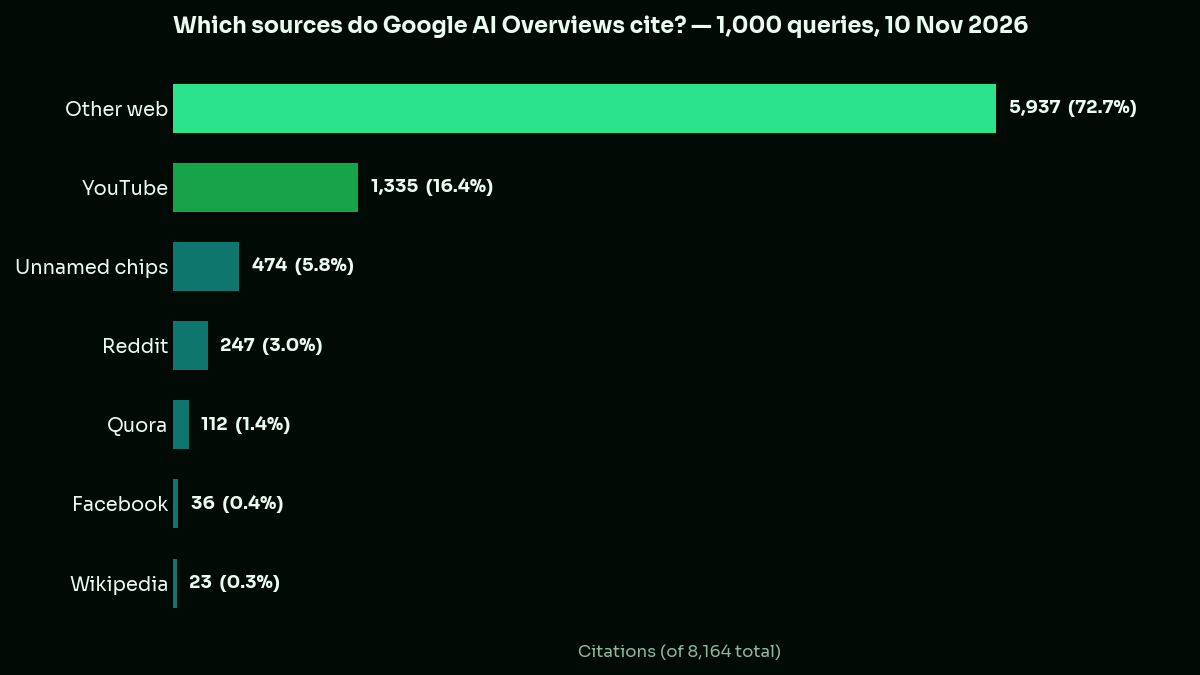
So what gets cited? In my 1,000 searches, the split was plain. Other websites took 72.7 percent of the citations. YouTube took 16.4 percent. Reddit took 3.0 percent. Quora took 1.4 percent. Facebook took 0.4 percent. Wikipedia took 0.3 percent. The rest was odds and ends I could not put a name to.
YouTube in second place is worth a pause. A video that answers a question well gets picked up the same way a good article does. If your company only writes and never records, you are giving away roughly one citation in six before you start.
The pages that kept showing up had a few things in common, and none of them were tricks. They answered one question properly, in plain words, instead of covering five keywords at once. They had a fact I could check, with a source attached. They were written by someone who had clearly done the work, not someone summarising three other articles. And they were easy to quote. Short sentences. A clear definition near the top. A number with a date on it.
That last part matters more than people think. An AI answer is built out of sentences it can lift. If your page buries the answer in the fourth paragraph, under a clever heading, there is nothing clean to lift. I have rewritten pages where the only change was moving the straight answer to the top, in two plain sentences, and the page started appearing in AI answers within weeks. Same facts. Same site. Different order.
Google's own help page says AI Overviews appear when its systems decide a generated summary would help the person searching. That tells you something useful. The answer box is not a slot you buy or pitch for. It shows up when Google thinks it helps, and the sources it picks are pages it already trusts.
Ranking is not dead
None of this means ranking is dead. I still watch positions for my clients every week, and I still fix the same boring things. Slow pages. Thin service pages. A Google Business Profile with the wrong hours on it.
A site that ranks well is also, most of the time, a site an AI system trusts enough to cite. The two jobs overlap. What has changed is the order of the work. Ranking gets you into the room. Being citable gets you named once you are there.
What I would do this week
If a tech company asked me this week, I would start with the ten questions their best customers actually ask before they buy. Not the keywords. The questions. Then I would write a page for each one that answers it properly. A real answer, with a real example from their own work. Not a sales page dressed up as a guide.
Then I would check what the AI answer says about their market today. Search the question yourself. Read the answer. Note who gets cited and who does not. If your competitors are in there and you are not, that gap is your brief. It tells you exactly which pages to write next.
And I would put a date and a source on every claim that matters. "Most companies" is not a claim. "In a test of 1,000 searches I ran in November 2026, 992 showed an AI Overview" is a claim, and I can stand behind it because I ran it. Editors can check it. Readers can argue with it. That is the point. A page with nothing checkable on it gives an AI system nothing to trust, and it gives a reader nothing to remember.
The last thing, and the least popular part, is to stop writing for the keyword and start writing for the question behind it. "Best CRM for small teams" is a keyword. The question behind it is "we have five people and no time, which tool will not waste our week?" A page that answers the second question will rank for the first one anyway, and it is the page an AI answer will quote, because it sounds like it was written for a person.
Write the page you would want to read before you spent your own money. Put your name on it. Then check next month whether the answer in your market names you. That is the whole job now, as far as I can see it.
RB Sojib is a Content Manager at sojib.bd, where he works on SEO and WordPress for clients in the US, UK and Australia. He writes about how AI search is changing the way people find businesses.
View all posts by RB