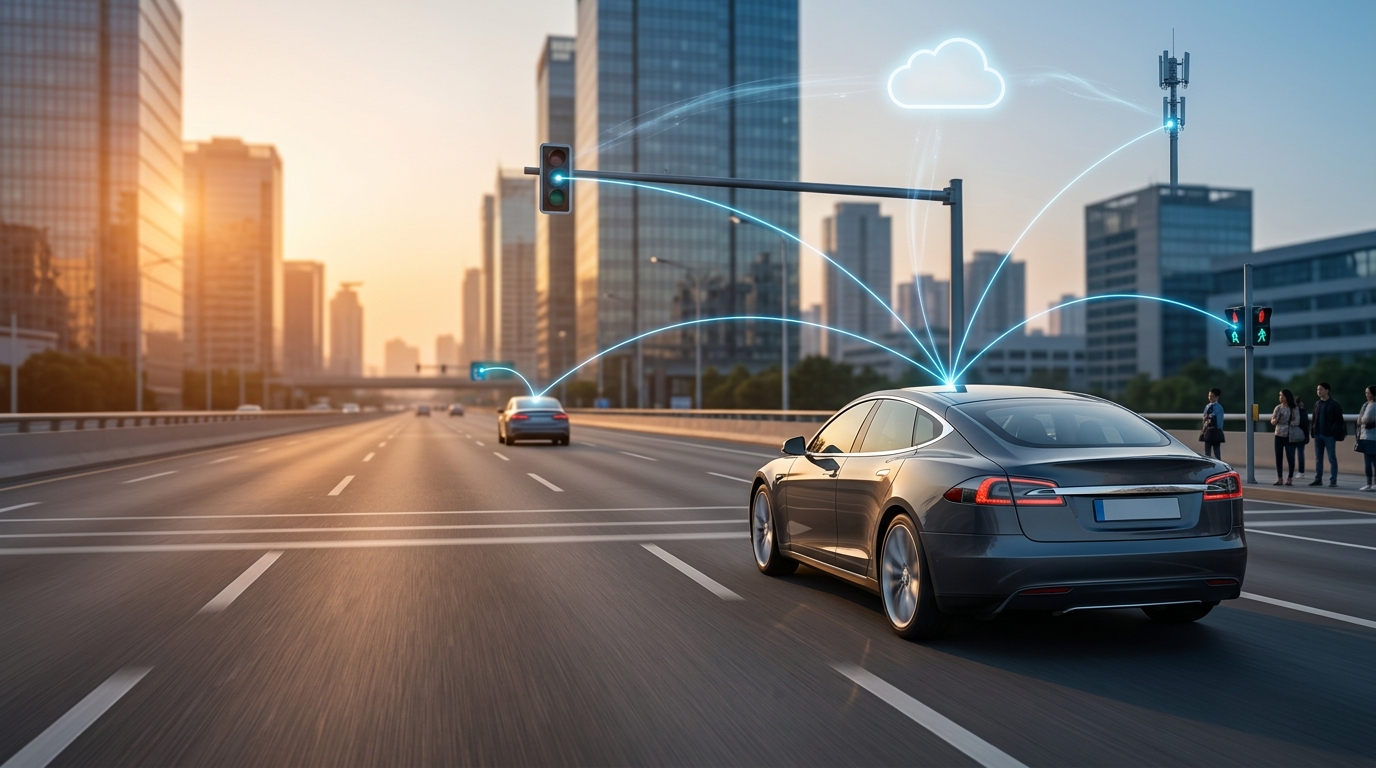
Cars were originally rated by their engines and how they drive. More and more often they are rated by their ability to collect information, exchange data, and learn. Nowadays, connected cars exchange information with other cars, other road elements, pedestrians, and the Internet. It creates new ways of manufacturing, servicing, and making cars safer. Four types of equipment are involved: sensors that see the road, radio communications sending information, clouds that process it, and auto software updates which inform cars about new improvements.
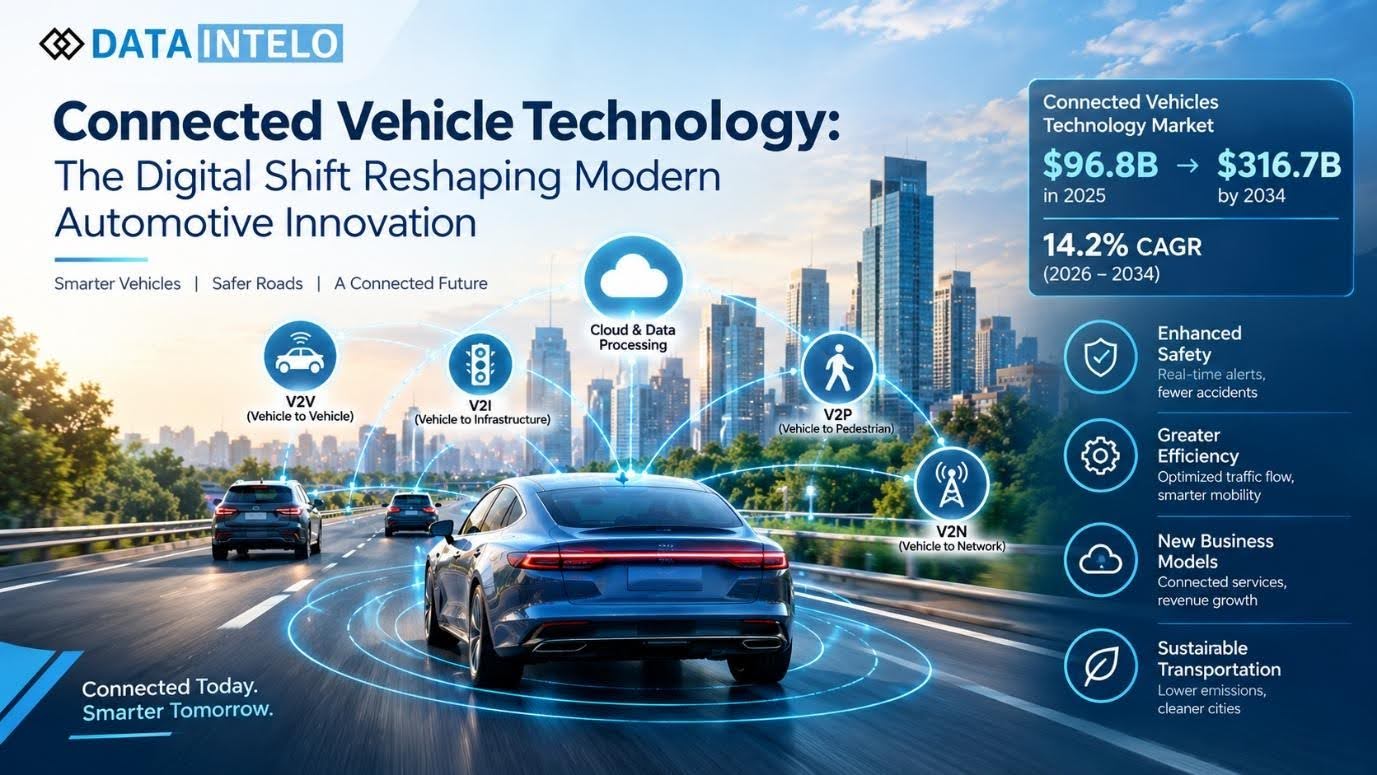
The volume of such changes is now evident. As a data research recently published by Dataintelo states, the market volume of connected vehicles technologies in 2025 was $96.8 billion and will grow to $316.7 billion by 2034 with 14.2% CAGR of growth from 2026 to 2034. It is an increase by 3.3 times during nine years and indicates a fundamental and not only a temporary trend. For car manufacturers, suppliers, traffic operators, and urban planners it means that connectivity will become more of a standard requirement and not an optional extra feature.
How Cars Became Network Nodes
There are various layers in connectivity. While embedded telematics units are used to capture the location, speed and diagnostics, communication links handle the other communication. Communication links are comprised of:
Vehicle to Vehicle (V2V): Vehicles receive signals about their location and brake-related information.
Vehicle to Infrastructure(V2I): Signals on traffic information, data on construction sites, as well as road sensors are generated.
Vehicle to Pedestrian (V2P): Mobile devices and wearables are being used in order to warn motorists of dangers posed by pedestrians and cyclists.
Vehicle to Network (V2N): The cloud supplies necessary information about maps, traffic data and software upgrades.
Two major radio communication methods exist: DSRC (Dedicated Short-Range Communications) and cellular communication with the help of LTE and 5 G. The selection depends on the particular region and country.
The Safety Case Comes First
Take away the marketing rhetoric and the most compelling case for connectivity is that human life is at stake. The National Highway Traffic Safety Administration estimates 39,345 people died in traffic incidents in 2024, which is a 3.8% decline from the deaths of 40,901 in 2023. The leap year of 2024 has over a period of 366 days resulted in an average of about 108 deaths per day. While some progress has been made, the NHTSA reports that the number of fatalities in the U.S. is quite high compared to other developed economies.
Connected vehicles fill in the gap that cameras or radar cannot fill. Onboard systems can only see what is visible for sensors. Thus, a connected car can be informed about hard braking before a turn or a stalled truck before any other sensors manage to register those events.
What the 80% Figure Really Means
The most commonly cited figure originates from federal safety research. In a 2022 presentation, the National Transportation Safety Board (NTSB) said that one study by NHTSA estimates that V2X technology could address up to 80% of road accidents not involving impaired drivers. In April 2021, after advising NHTSA of the benefits of connected vehicle technology twice already, the NTSB put it on its Most Wanted List.
However, it is important to underscore two caveats. One is that “up to 80%” reflects an optimistic estimate rather than being based on real-life data. The second caveat states that the actual adoption of V2X technology will depend both on the availability of vehicles equipped with this solution and the number of crossroads benefited from it in particular.
Reading the Fatality Trend Honestly
Connected technologies are not the main factor behind the drop in fatalities; this would be a false impression. NHTSA does not attribute the decline to a single cause, but says it is working with law enforcement to strengthen enforcement against speeding, impaired driving, distraction and non-use of seatbelts. Yet, strewn throughout the findings, there are examples showing the solution to the problem exists. In 2022, the number of fatalities was 42,721, and in 2024 it reached 39,345, a decrease of 3,376 deaths or 7.9% for 2 years. The last quarter of 2024 became the 11th quarter in a row of the ongoing decline.
However, the statistics are quite paradoxical. NHTSA estimated there were lower deaths in 35 states and Puerto Rico, but in 14 states and the District of Columbia the numbers increased.
<table style="border-collapse: collapse; width: 100%; font-family: Calibri, Arial, sans-serif; font-size: 14px;">
<thead>
<tr>
<th style="border: 1px solid #000; padding: 6px; text-align: center; color: #4472C4;">Metric</th>
<th style="border: 1px solid #000; padding: 6px; text-align: center; color: #4472C4;">Figure</th>
<th style="border: 1px solid #000; padding: 6px; text-align: center; color: #4472C4;">Source</th>
</tr>
</thead>
<tbody>
<tr>
<td style="border: 1px solid #000; padding: 6px;">U.S. traffic deaths, 2023</td>
<td style="border: 1px solid #000; padding: 6px;">40,901</td>
<td style="border: 1px solid #000; padding: 6px;">NHTSA</td>
</tr>
<tr>
<td style="border: 1px solid #000; padding: 6px;">U.S. traffic deaths, 2024 (early estimate)</td>
<td style="border: 1px solid #000; padding: 6px;">39,345</td>
<td style="border: 1px solid #000; padding: 6px;">NHTSA</td>
</tr>
<tr>
<td style="border: 1px solid #000; padding: 6px;">Crashes V2X could address (non-impaired drivers)</td>
<td style="border: 1px solid #000; padding: 6px;">Up to 80%</td>
<td style="border: 1px solid #000; padding: 6px;">NHTSA study, cited by NTSB</td>
</tr>
<tr>
<td style="border: 1px solid #000; padding: 6px;">Connected vehicles technology value, 2025</td>
<td style="border: 1px solid #000; padding: 6px;">$96.8 billion</td>
<td style="border: 1px solid #000; padding: 6px;">Industry report</td>
</tr>
<tr>
<td style="border: 1px solid #000; padding: 6px;">Projected value, 2034</td>
<td style="border: 1px solid #000; padding: 6px;">$316.7 billion</td>
<td style="border: 1px solid #000; padding: 6px;">Industry report</td>
</tr>
</tbody>
</table>
Software Changes the Ownership Model
It is clear that connectivity fundamentally alters the understanding of a vehicle once it has left the factory. For instance, manufacturers can fix defects and patches remotely and begin diagnostics before a breakdown occurs. The relationship between manufacturer and customer becomes continuous instead of being merely transactional.
This is reflected in its financial pattern as well. The growth of $96.8 billion to $316.7 billion gives an increase of almost $220 billion value within nine years, or about $24 billion per year. Each year, annual growth of 14.2% means that every year’s growth is going to be greater than the previous one.
The Hard Problems Still Ahead
Each new link is a potential entry point which means that reliance will be based only on the security and privacy. In this case, three security measures are especially important:
Authentication: every incoming message must come from the authorized sender.
Encryption: all driving and location data should be safe while being transferred and stored.
Integrity of updates: software updates must be signed to avoid forgery.
Interoperability is the second issue—if a car is produced in a certain country, it must communicate with equipment in another country or its ones. The third issue is the cost because installation of devices at intersections requires significant funding.
A Measured Outlook
The image is not that of excessive optimism nor excessive doubts. The market for connected vehicles is expected to increase by a factor of 3.3 by 2034; the ceiling for independent research conducted by U.S. government scientists stands at 80% of crashes not involving an impaired driver, and the number of victims that the technology aims to spare is still close to the amount of 39,345 victims only in one country. Altogether, those three figures explain why the investment continues despite obstacles.
Success will not depend on a single breakthrough; it will depend on systematic work involving joint standards, secure software, financed infrastructure, and correct reporting of results.
Ashish Kolte is a Marketing Manager at Dataintelo with expertise in marketing, market intelligence, and business strategy. He combines marketing insights with industry research to help organizations understand market dynamics, identify growth opportunities, and make data-driven decisions. His areas of interest include emerging technologies, artificial intelligence, healthcare, industrial markets, and global business trends. Through his writing, Ashish shares research-backed perspectives on evolving industries and strategic market developments.
View all posts by Ashish

