
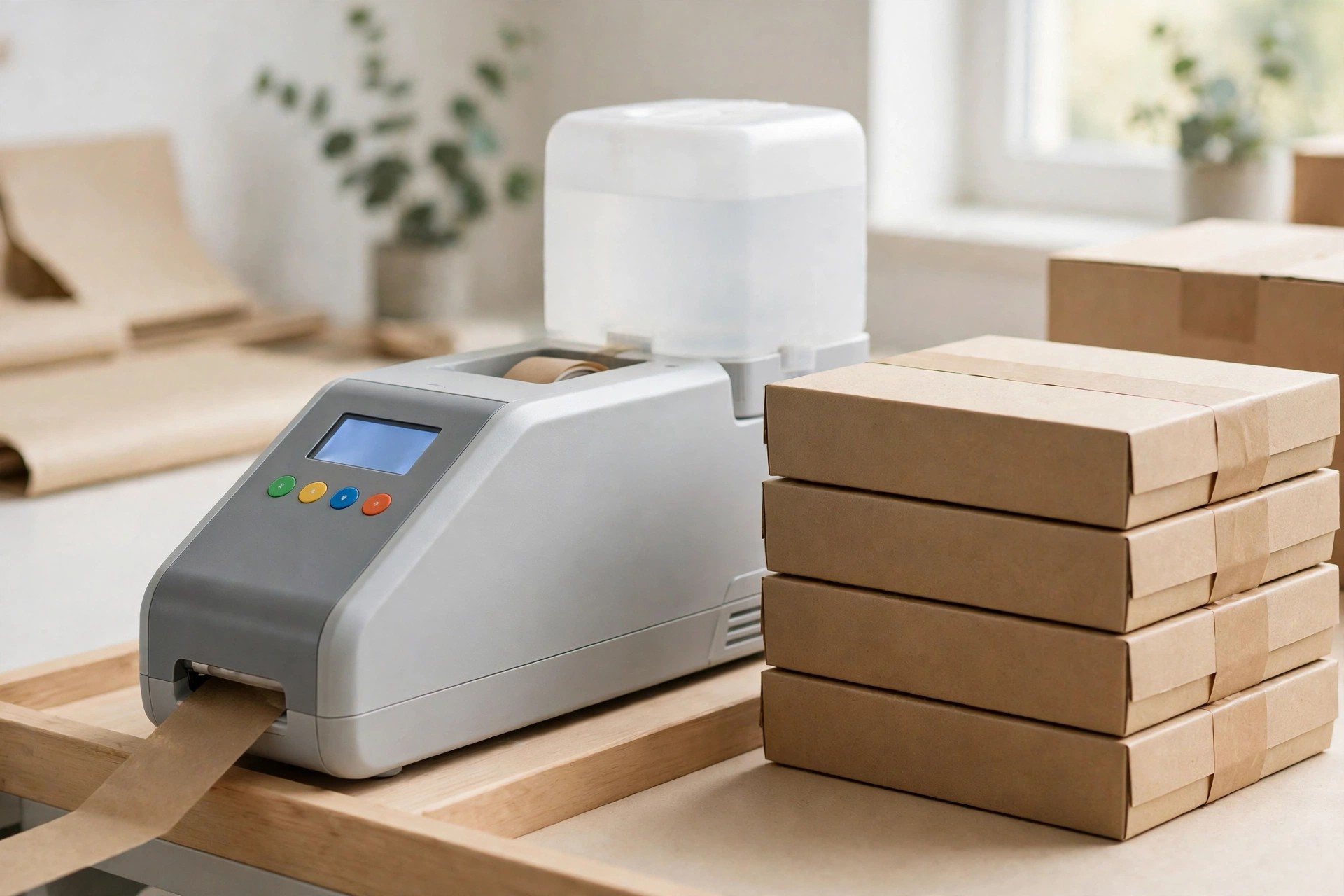
For a small brand, the parcel is the shop window. The box, the tissue, the thank-you card — all paper, all recyclable, all on brand. Then the tape: a strip of plastic that the customer has to cut off and bin. It is a small thing, but it is the last piece of plastic in an otherwise plastic-free parcel, and customers notice it.
Water-activated tape fixes that mismatch without asking a small packing line to slow down. This is a practical guide to making the switch: what the tape is, how to pick the right grade, what equipment you actually need, and where it is the wrong choice.
What water-activated tape actually is
Water-activated tape — also called gummed paper tape — is kraft paper with a starch-based adhesive coating. Brushing or rolling water over the adhesive activates it, and the adhesive bonds with the fibres of the carton itself. Once dry, the tape is not sitting on the box; it has become part of the box.
That is what makes it different from plastic tape in three ways that matter to a small brand:
- It recycles with the carton. The tape is paper and starch adhesive, so a sealed box goes into the paper recycling stream as one item. There is nothing for the customer to peel off.
- It shows tampering. Opening a water-activated seal tears carton fibres, so a broken seal is obvious. For a small brand shipping higher-value goods, that is free tamper evidence.
- It looks like you meant it. A single neat strip of kraft tape reads as deliberate packaging, not as a box that was taped shut in a hurry.
Our tape is made with FSC-certified paper, and independent testing found PFAS not detected in our water-activated range. Those are the two claims customers and retailers ask us about most, so check them on any tape you buy.
Why it suits a small packing line
Small brands usually pack by hand, in batches, at one bench. Water-activated tape fits that rhythm better than most people expect:
- One strip does the job. A reinforced water-activated tape seals the centre seam with a single strip, where plastic tape often needs an H-pattern of three strips to feel secure. Fewer strips means less tape per parcel and a faster pack.
- It works with the cartons you already buy. Standard single-wall and double-wall corrugated cartons are the right surface; the adhesive keys into the board.
- It keeps the unboxing clean. The customer opens the box by cutting or tearing one paper strip, and the whole parcel — box, tape and all — can go in the paper bin.
Pick the tape by carton weight
The most common mistake is buying one tape for every parcel. Tape grades are built for weight bands, and matching the grade to the carton is what keeps parcels shut in transit. As a starting point, using our own range as an example:
Carton weight | Tape to start with |
Up to 10 lb (4.5 kg) | Lightweight non-reinforced water-activated tape, e.g. JLN-370 / JLN-382 |
10–35 lb (4.5–16 kg) | Medium water-activated tape, e.g. JLN-3140 / JLN-3150 |
35–55 lb (16–25 kg) | Reinforced water-activated tape, e.g. JLN-3160 / JLN-3750 |
55–90 lb (25–41 kg) | Heavy reinforced water-activated tape, e.g. JLN-3780 |
Over 90 lb (41 kg) | Extra-heavy reinforced water-activated tape, e.g. JLN-37120 / JLN-37120R |
Two things to note. First, reinforced tape — tape with fibres laminated into the paper — is what carries the heavier bands; non-reinforced tape is fine for light parcels but should not be stretched to heavy ones. Second, these are starting points, not a guarantee: run a trial seal on your own cartons, with your own fill, and drop-test a few parcels before you switch the whole line over.
The dispenser question: manual or electric
Water-activated tape needs water, and that means a dispenser. For a small brand, the choice is simple:
- Manual dispenser (for example our KN-266) for low volume — a few dozen parcels a day. You pull the tape, the dispenser wets it, you tear and stick. No power needed.
- Electric dispenser (for example our KN-366Hi) once volume grows. It cuts preset lengths at the touch of a button, so every strip is the same length and tape waste drops. It pays for itself in saved tape and saved seconds per parcel.
You do not need a case sealer to start, and you do not need compressed air. A bench, a dispenser and a water top-up are the whole setup.
Where water-activated tape is the wrong default
Honesty matters here, because the wrong tape in the wrong place is how small brands go back to plastic. Water-activated tape needs water and a dispenser, so it is the wrong default anywhere you pack without a water station: market stalls, pop-up shops, trade shows, or packing in the field.
In those places, use self-adhesive kraft tape instead. It is pressure-sensitive, hot-melt adhesive, and it sticks on contact — no water, no dispenser. It is still paper tape, so the parcel stays plastic-free. Keep water-activated tape as the backup for the packing bench, where a water station is in place and fibre-level tamper evidence is the priority.
Storage and shelf life
Tape is a perishable product, and small brands often buy in bulk and forget it. Store water-activated tape at 4–26°C (39–79°F) and 40–50% relative humidity, in its original packaging, away from damp and direct sun. Under those conditions, water-activated tape keeps for about two years; self-adhesive kraft tape for about one year. If a roll has been sitting open in a humid room for months, test it before you trust it on customer orders.
A five-step rollout
1. Audit what you use now. Count the strips per parcel and the tape spend per month. That is your baseline.
2. Weigh your typical cartons. Pack five representative orders and weigh them. That tells you which weight band — and which tape grade — covers most of your volume.
3. Trial one grade. Buy one weight band first, not the whole range. Seal ten parcels, drop-test three, and ship the rest to friends or staff.
4. Train the bench. The two errors are under-wetting (the tape never bonds) and over-wetting (the tape slides and wrinkles). One even pass of water, firm pressure, and a few seconds to set is the whole technique.
5. Measure for a month. Tape used per parcel, parcels re-taped, and any transit damage. If the numbers hold, roll the grade out across your range.
The bottom line
For a small brand, sustainable packaging is not a separate project; it is the parcel the customer already holds. Water-activated tape removes the last strip of plastic from that parcel, seals as fast as the plastic it replaces, and gives you tamper evidence for free. Pick the grade by carton weight, start with a manual dispenser, and keep self-adhesive kraft tape on hand for anywhere without a water station.
For a fuller explanation of how the starch adhesive bonds with carton fibres and why the sealed box stays curbside-recyclable, see our guide to water-activated tape.
Zhenhang Zhong works at JL3 (Fujian Jialong Adhesive Tape), a manufacturer of packaging tape and carton sealing equipment. He writes about carton sealing, packaging materials and fulfilment operations.
View all posts by Zhenhang